
The Light Switch

How a 140-year-old invention quietly works against your body clock.
The humble light switch, which almost everyone on the planet takes for granted, has only been around for about 140 years. It arrived just four years after the electric light bulb was commercially released.
The first practical switch was invented by John Henry Holmes of Newcastle upon Tyne.
In those early years, switching lights on and off was a dangerous affair with the risk of shock and damage to the crude, knife-style lever switches.
But is it possible the biggest danger of the light switch is only now coming to light...its effect on our biology?
Early quick-break switches on an electrical panel. Light Switch
The Ancient Link is Broken
Before artificial light and the switch, we had to follow the natural timing of the Sun. Human activity was dictated by the light-and-dark cycle across 24 hours. Then artificial light arrived, followed by the light switch, and it handed us control, letting us extend daylight well past the natural sunset. We could, and now do, live active lives and carry out tasks late into the night for as long as we like. We decide when the lights go out and come back on.
Light is a Biological Signal
For millions of years our biology tied bright light to one thing: the Sun is up, and it is daytime. When light reaches the eye, it does more than form an image it raises alertness, influences sleep timing, and helps adjust the circadian clock. Light is not only a visual tool. It is also a biological signal and the most important signal, or Zeitgeber ('time-giver'), has always been the Sun. Then, with the flick of a switch, we broke that ancient connection. The impact of the humble light switch may be more significant than you think.
Of Mice and Switches
Scientists at the University of Manchester did something simple and clever: they gave mice control of the light. The study, led by Rebecca Hughes and Robert Lucas, was published in Current Biology. The animals were striped mice (Rhabdomys pumilio), a diurnal African rodent. Unlike most lab rodents, these mice are day active like us. Each mouse lived in a cage with two platforms: one stepped the light up, the other stepped it down, through four levels from full dark to bright. With no training they simply moved to change its light.

Hughes et al., Biology (2026). Fig 1 - the self-selected-light cage
A Hint of Our Own Habits
Given the choice, the mice picked the brightest light when awake and total darkness to rest. Light became a signal of being active not a signal of what time it is. That is the human pattern too. And that is exactly where the trouble starts.
Light doesn't just Follow Being Awake it Fuels it
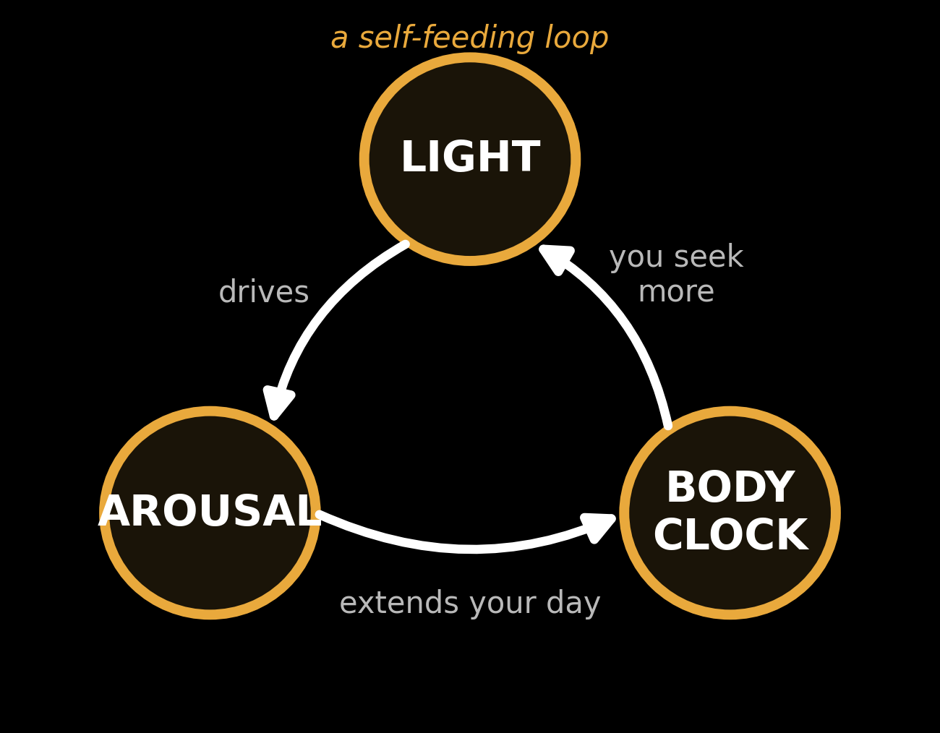
Self-selected light became a self-feeding loop: brighter light drove the mice to be more active, and being more active pushed them to choose even more light. The result — a longer active phase and a shifted internal clock.
Reading the Rhythm
The graph below maps the mouse’s activity across day and night. The fixed light period is shown in yellow. Without the switch (top), this striped mouse keeps a tight, daytime rhythm. With the switch (bottom), activity bleeds into the night and its clock period drifts.

Hughes et al., Biology (2026). Fig 3A. - SSL = no switch +SSL = with switch.
What the Animals Chose
The animals learned to control their light environment spontaneously. When active, they preferred the brightest light available. When inactive or ready to rest, they chose darkness. This matters because light was not simply imposed on them, it was chosen. The finding suggests that at least in this day-active species, bright light can be an innate preference during wakefulness. It also supports the idea that light and arousal are linked in both directions: being awake makes light attractive, and light promotes activity.
Biological Timing
Over time, self-selected light did more than accompany activity, it affected the timing system itself. Access to it could alter circadian period and extend the active phase. Under certain light–dark conditions it also increased activity during the usual dark phase and disrupted entrainment, especially when self-selected light was equal to or brighter than the imposed cycle. It could even interfere with phase resetting, substantially delaying re-entrainment after some shifts in the external light dark cycle. In plain language: controlling light was not neutral. It changed both the expression of activity and how robustly the internal clock stayed aligned.
And Then There's Us
Humans have pressures animals do not. We use light for work, caregiving, social life, entertainment, safety, screens, and habit. We don’t just respond to light; we organise modern life around it. So, the biological feedback loop from the study may be amplified in human environments. Its value is showing that the intrinsic links between light, arousal, and the clock exist even without work, screens, or social pressure. Modern culture then gives that mechanism far more opportunities to run late into the night. This is why lighting design matters. The question is not whether light is good or bad, it is whether the right light reaches people at the right time.
The Light Switch - A Strange Invention
The light switch is not evil. But biologically, it is a strange invention. Imagine switching daylight on and off in an instant. In nature that makes no sense: daylight rises gradually, changes through the day, fades into evening, and gives way to darkness. With electric light, we override that entire rhythm with one small action. Our circadian system has not caught up. To the body, light still carries biological meaning, and it still signals daytime, alertness, and wakefulness, even when the clock on the wall says night.
Make Light Wiser
The opportunity is not to reject artificial light, but to make it wiser.
We live in an age where lighting can be automated, dimmed, tuned, and timed to follow the natural cycles of day and night. We can teach animals to use light switches. But we cannot teach them circadian science. Humans can learn both.

References & Sources
The Research
Hughes RB, Bañó-Otálora B, Davey M, Martial FP, Babu A, Wynne J, Brown TM, Lucas RJ. The impact of self-selected light on activity rhythms in the diurnal striped mouse. Current Biology. 2026;36:1–12. doi:10.1016/j.cub.2026.03.036
The Light Switch
Holmes JH. Electric-Circuit Closer. US Patent No. 305,310 — granted 16 Sep 1884. (UK: GB Patent No. 3,256 of 1884.) ‘John Henry Holmes.’ Wikipedia.
‘John Henry Holmes.’ Grace’s Guide to British Industrial History.
Sagar P. ‘John Henry Holmes: electrical leading light.’ Heaton History Group, 18 Jul 2020.
Original quick-break switch on display: Discovery Museum, Newcastle (Tyne & Wear Archives & Museums).
Context: Joseph Swan’s incandescent lamp, publicly demonstrated 1880 (Newcastle / Sunderland).
Image and Figure Credits
Early quick-break switches on an electrical panel. Source: Heaton History Group
Research figures (light-switch cage, activity actograms): Hughes et al., Current Biology (2026) — reproduced and adapted under the Creative Commons CC BY 4.0 licence.
Striped mouse (Rhabdomys pumilio): Wikimedia Commons — Creative Commons (see file page for author).
Feedback-loop and solar-cycle graphics: original illustrations, Dhatt Light Man.


Comments